Before the Headset: The Idea of Entering an Image
See how panoramas invited viewers into a depicted world, and learn what their approach to enclosure and attention can teach virtual reality designers.
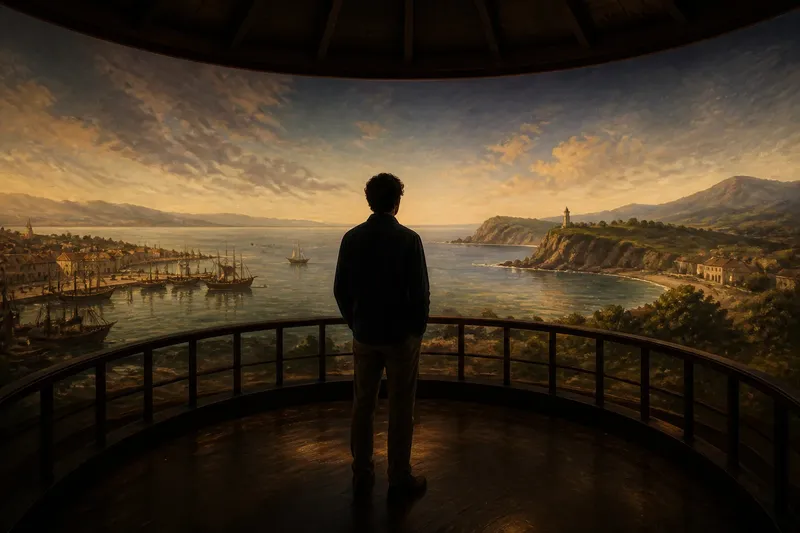
Stand near the center of a circular room, and a painted coastline can curve around you: harbor in one direction, headland in another. The scene is still paint on a wall, yet turning your head reveals more of its world. This early form of immersive imagery offers a useful way to understand how people began to imagine entering an image.
Origins of Immersive Imagery
This is a conceptual account of an idea, not a timeline of particular installations. The panorama matters here as a viewing arrangement: unlike a framed picture, it carries a depiction around the viewer and makes looking around part of the encounter.
The distinction is not simply between old images and newer, more detailed ones. A panorama changes the viewer’s relation to the scene by surrounding them with it. The room and the image work together to make a depicted place feel encompassing, even though the viewer remains in a physical interior.
That idea predates virtual reality headsets. A curved painted scene can invite the viewer to turn without moving at all; a headset can present a rendered environment that responds to the wearer’s direction of view. The technologies differ, but both raise a shared design question: what should the viewer encounter when they look away from the main point?
The Surrounding Image
A framed painting asks you to look toward it. A panorama changes that arrangement by carrying the depicted scene around the viewer. Instead of composing a single rectangle, its maker distributes the image across a curved interior, often with the viewer standing near the center. Turn your head, and the view continues.
Enclosure can make a scene feel expansive without making it physically present. A distant mountain, harbor, or battlefield may occupy much of the visual field, while the viewer remains on a platform inside a purpose-built room. The image does not need to move; the viewer’s body supplies the movement of looking.
For virtual reality designers, the useful question is not simply how detailed a scene can become. It is what happens when a viewer turns away from the main point. A panorama answers by extending the depicted world around them; a conventional picture lets its edges remain visible.
Choosing the View
A panorama is not automatically the best form for every subject. Its strength is the feeling of being surrounded, which can become a distraction when the subject needs one clear, fixed point of attention.
- If the subject is a place: Check whether important features continue around the viewer. If they do, use an enclosed panorama to support looking around; if they do not, keep the view more focused so the scene does not promise continuity it cannot provide.
- If the subject is one moment: Check whether a gesture, object, or event carries the meaning. If it does, use a framed or directed view; if context around it matters just as much, include only the surrounding details that clarify the moment.
- If the viewer should explore: Check whether different directions offer meaningful, connected discoveries. If they do, let the scene invite turning; if they do not, guide attention toward the area that carries the subject.
- If the viewer should compare details: Check whether close inspection matters more than the sensation of being surrounded. If it does, present details in a view that can be scanned comfortably; if the overall setting matters more, use enclosure and keep the details subordinate.
These decisions concern attention and space, not which image is more advanced. A quiet, limited view can be easier to read, while a surrounding view can make a place feel unusually encompassing.
How Panoramas Guide Attention
With a framed picture, the frame gives the eye a boundary. In a panorama, that boundary may be difficult to locate while the viewer faces into the scene. The shift encourages a different kind of attention: less like inspecting an object and more like orienting oneself within a place.
Enclosure does not mean every direction deserves equal emphasis. A strong landmark can sit ahead, with quieter details to either side. The viewer can take in the broad setting, then use a tower, ridge, or shoreline as a reference when looking elsewhere.
A fully surrounding scene can leave a newcomer unsure where to look, especially if every direction competes at once. Visual anchors—recognizable features that connect different views—help make the depicted space easier to understand without forcing everyone along the same route.
Say you are adapting an invented seaside panorama for a virtual gallery. You place a lighthouse near the main opening, then add a boat and headland farther around the curve. A visitor who turns from the lighthouse still finds features linked to the same coast, so looking around can reveal more without making the geography feel arbitrary.
Room, Image, and Body
A panorama’s effect comes from more than its painted surface. The room positions the viewer, the image supplies the surrounding scene, and the body makes turning possible. Change any one of those parts, and the experience changes too.
A narrow opening or a carefully positioned viewing platform can guide where someone stands. A larger interior can allow more freedom to move, but it may also reveal the image’s edge or make the depicted horizon feel less continuous. The decision is not simply to make a bigger room; it is to choose how much of the viewing arrangement should remain perceptible.
Virtual reality changes the physical setup, but not the underlying question. A headset can fill the view with a rendered scene while the wearer’s actual surroundings recede from attention. The scene still needs to make sense as the wearer turns, and landmarks still help connect one direction to another.
The comparison has limits. A room-sized panorama places a viewer inside a shared physical installation, while a headset presents a computer-generated view to an individual wearer. What they share is an artistic ambition, not one technology or an interchangeable experience.
Panorama Questions?
What makes a panorama immersive?
A panorama occupies enough of the viewer’s view to suggest a surrounding environment. Curved walls can help, as can a consistent horizon and a scene that continues beyond the initial direction of attention.
Why do panoramas surround viewers?
Enclosure reduces visual reminders that a scene is a picture on a flat surface. It also lets viewers discover more of the depiction by turning their heads, making bodily looking part of the experience.
Does a panorama need moving images?
No. A still panorama can feel expansive because the viewer changes their gaze within a continuous scene. Motion can add another layer, but it is not required for the basic idea of entering an image.
What can a panorama leave out?
A surrounding image may obscure the room’s edges, the physical frame, or other cues that draw attention to the display itself. It cannot make the depicted place physically real, and it need not try.
What Is Not Worth Chasing
It is not worth adding visual detail in every direction just to prove that a scene is immersive. A crowded horizon can scatter attention, and ornamental scenery may do little to help someone understand the place. Enclosure depends on continuity and orientation as much as abundance.
Nor does a panorama need to hide every clue that it is constructed. A visitor can know that a scene is painted and still feel its scale while looking around. Treating that awareness as a failure misses the point: immersion can be a strong way of seeing without requiring literal belief.
When judging an immersive image, ask what the surrounding view contributes. Does it make the place easier to imagine, give the viewer a reason to turn, or connect separate landmarks into one scene? If not, a simpler composition may serve the subject better.
From Panorama to Virtual Reality
The idea of entering an image begins with a perceptual arrangement: the viewer is surrounded by a depiction and can explore it by looking. Panoramas made that arrangement tangible through a curved scene and a room designed around the act of viewing.
Virtual reality carries the question into another medium. A designer must decide whether to surround the wearer, where to place visual anchors, and how the scene should remain understandable when attention shifts. The panorama’s approach to enclosure still helps explain how an image can shape a viewer’s relation to a depicted world.
The next time a virtual scene feels like a place rather than a picture, notice what holds it together: a continuous horizon, a landmark that helps you orient, or a view that gives your turning a purpose. That small act of looking reveals the enduring idea behind immersive imagery: a viewer can stand inside a depiction and find more of its world by looking around.